


Blue Mosque: The Ottoman Symbol of Power and Elegance
- Kadir Küçükeren

- Mar 6
- 14 min read
Updated: May 1

Where Empires Overlap: Hagia Sophia, the Palace, and a New Ottoman Claim
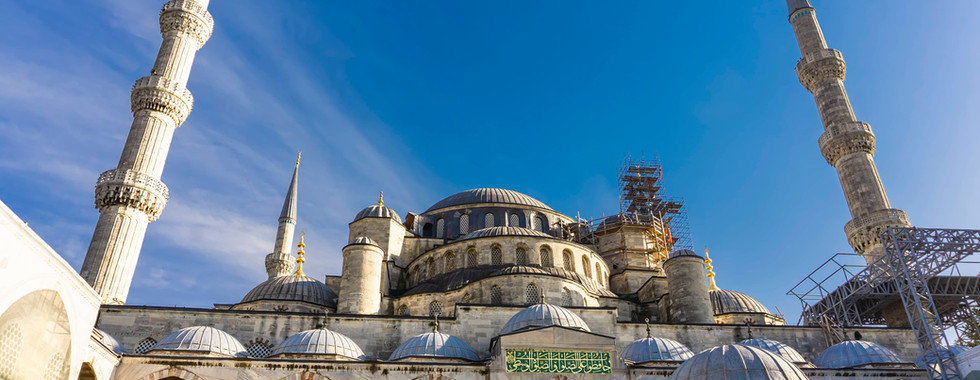
Crucially, it is the Sultan Ahmed Mosque (the Blue Mosque)’s location that transforms it from an architectural masterpiece into a bold statement of power. The complex is located in the political and religious centre of Byzantine Constantinople, on the square formed by the Hippodrome and the Great Palace, and is positioned directly opposite Hagia Sophia. Some sources suggest that this choice was not purely practical, but rather a deliberate decision with profound symbolic significance. Although other sites were reportedly considered, the decision to build opposite the “great temple” established a relationship of comparison and assertion from the outset. The material details in these accounts reinforce this message: the courtyard paving is said to have been made from reused seating stones from the Hippodrome, and parts of the mosque’s structure are said to have incorporated spolia from the Hippodrome and the Great Palace. In this sense, the new monument carried the memory of the old imperial centre within its very fabric. The Blue Mosque was therefore more than just a major mosque in the city centre. Located alongside the public-political arena of the Hippodrome and the sacred authority of Hagia Sophia, it can be interpreted as an Ottoman attempt to reinterpret this ancient core through the language of legitimacy—an architectural claim that begins with the location itself.
A Young Sultan, an Anxious Empire
When Sultan Ahmed I ascended the throne at the age of thirteen, he inherited an empire no longer sustained by the rapid expansion—and the spoils—that had underwritten earlier grandeur. In a period of stagnation and economic strain, committing regular funds from the treasury to a vast imperial complex was bound to provoke controversy.
At the same time, the traditional ideal of the “sultan-conqueror,” central to Ottoman sovereign ideology, had become increasingly difficult to perform. The 1606 agreement with the Habsburgs not only reflected the limits of Ottoman power on the battlefield; it also carried an implication of parity that unsettled the older language of supremacy. In this context, Sultan Ahmed I’s piety and his determination to build an Istanbul complex that would surpass its predecessors can be read as both personal ambition and political necessity: a bid to articulate legitimacy in the capital through stone, ceremony, and spectacle at a moment when military victory could no longer serve as the primary proof of authority. Contemporary and near-contemporary accounts emphasise the young sultan’s exceptional commitment to the project, noting that he is said to have visited the construction site in person in order to hasten the work. The same narratives add a final, almost elegiac detail: he died soon after the mosque’s completion, at the age of twenty-seven, before he could fully inhabit—or enjoy—the achievement he had so intensely pursued.


Seven Years of Mobilization: Organization, Labor, Logistics — and Sedefkâr Mehmed Ağa’s Calculated Dialogue with Hagia Sophia
The construction between 1609 and 1616 progressed more like a controlled mobilisation in the capital city centre than a classic “complex construction.” The choice of location already turned the project into a logistical undertaking from the outset: situated in the Atmeydanı, on the upper terraces of the old Great Palace, on a vaulted but cramped site, space was cleared by systematically dismantling the wealthy mansions in the area, and the resulting materials were reused. This chain of dismantling and rebuilding extends even further back: stone blocks salvaged from the remains of the Hippodrome and the palace, which had stood in the area for centuries, are also incorporated into the structure’s core; it is even specifically emphasised that stones from the Hippodrome seating rows were used in the courtyard paving. Thus, the construction site is not merely a flow bringing in new materials; it is an organism that “uproots the old imperial sediment around it and transforms it into a new order.”
The figure who translates this mobilisation into architectural language is Sedefkâr Mehmed Ağa, trained in the Sinan tradition. His approach was not to compete directly with Hagia Sophia in terms of dome diameter; rather, it was to establish an imposing mass in the external silhouette, creating an imperial signature that would not be overshadowed when set side by side with the colossal structure opposite.
Therefore, the logic of the plan invokes two separate legacies simultaneously: on the one hand, the symmetrical, layered dome-cluster arrangement reminiscent of Sinan’s Şehzade Mosque; on the other, an explicit reference to Hagia Sophia’s dome-and-half-dome composition. While the interior strives to create lightness through the light admitted by hundreds of windows, the configuration of four giant “elephant legs” bearing the central load divides the space sharply, producing a fragmented effect. For this reason, the building is often discussed not in terms of perfect internal unity, but rather as a declaration of power and splendour that does not fall short of Hagia Sophia when viewed from the outside.



A Cascading Dome System: Weight, Light, and Sound
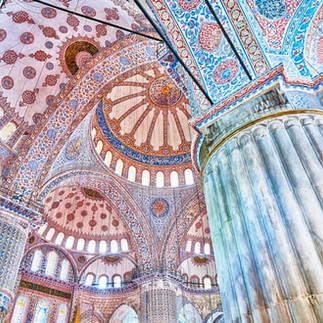
Step inside the prayer hall and the whole building reads like a controlled “cascade” of domes—an Ottoman square plan crowned by a main dome and ringed by semi-domes that step down in scale, keeping the space both monumental and legible. The core is the central dome (about 23.5 m in internal diameter and rising to about 43 m), set over a prayer hall measuring roughly 64 × 72 m, and surrounded by four semi-domes that continue the load outward in a symmetrical, almost staged progression. This isn’t just visual rhythm; it’s structural strategy. Each major semi-dome is further “broken down” by smaller semi-domes and exedrae, so thrust is distributed in steps rather than dumped into a single perimeter ring—one reason the whole mass feels carefully graduated instead of abrupt.
But that calm geometry rests on an unapologetically physical structure: four massive piers carry the dome’s weight, and unlike Hagia Sophia’s famously “mystified” supports, these piers are felt as dominant vertical anchors that reframe your view as you move. Structurally, the prayer hall reads as a clear load path: dome loads are gathered by the main arches and transferred downward through those piers; the cascading half-domes function not only as spatial expansions but also as buttressing masses, stabilising the main shell by redirecting thrust into the stepped envelope. Even without resorting to equations, the building “shows its work” in the way each dome tier is paired with a counter-mass below it.
And sound follows sight. A multi-domed, concave ceiling is acoustically risky—domes can trap reflections and create delayed returns (echo-like effects) that reduce intelligibility. What is fascinating is that there is documentation for cavity resonators (Helmholtz resonators) in Ottoman dome acoustics, and the Blue Mosque is explicitly discussed in this context: during restoration work, resonator openings and plugged resonators in the dome of the Sultan Ahmed Mosque are illustrated and described as part of a system intended to diffuse sound energy and reduce problematic delayed reflections from the concave shell. In experiential terms, that matches what you feel inside: the hall remains highly reverberant (a long, lingering canopy of sound is part of the intended sacred “presence”), but the architectural and acoustic logic aims to keep that reverberation coherent—less “slapback,” more an enveloping field—so Qur’an recitation can ride the volume rather than dissolve into noise.
The main prayer hall is generally reported to accommodate about 10,000 worshippers, while the mosque complex with its courtyard is often given as holding around 12,000 worshippers at once.




The Six Minarets: Prestige, Piety, and a Carefully Managed Controversy
Imperial mosques in Istanbul already spoke the language of rank through their silhouettes: minarets were not merely functional towers, but public declarations of patronage and hierarchy. In that visual grammar, the decision to give Sultanahmet six minarets read immediately as an escalation—two additional minarets flanking the courtyard corners, alongside the four tied to the main mass—pushing the total beyond what Constantinople had seen for an imperial foundation. Contemporary perception mattered as much as masonry. The move was widely interpreted as overreach, because it seemed to place the new mosque above earlier dynastic monuments in the city and—more sensitive still—on a level with the Great Mosque in Mecca.
That is why the “six-minaret issue” quickly became a theological and political problem to be defused rather than debated. The most concrete “fix” preserved in historical narration is pragmatic rather than rhetorical: to blunt accusations of impiety, the court is said to have sponsored the addition of a seventh minaret in Mecca, reasserting the sanctuary’s primacy and turning a potential scandal into a managed hierarchy.
Modern art-historical summaries still frame the episode in these terms: six minarets were unusual enough to suggest parity with Mecca, and the story of a seventh minaret serves as the symbolic repair. (Later folklore explanations also circulate—such as a supposed mishearing of “gold minarets” as “six minarets”—but these are typically presented as legend rather than as a documented record of decision-making.)


A City Within a City: The Külliye as an Urban Engine
In Ottoman Istanbul, an imperial mosque was never designed to stand alone; it was meant to function like a small city—feeding, teaching, healing, housing, and financing itself through a web of charitable and commercial units. That logic is especially visible at Sultanahmet, where the prayer hall and its monumental courtyard formed only the ceremonial core of a much wider institution: a medrese for higher learning and other schools, a primary school, a hospital (dârüşşifâ) with its own ancillary spaces, an imaret complex with kitchens, bakery, storerooms, and refectory functions, tabhane-style lodgings, fountains and sebils, and a dense layer of shops and service buildings intended to generate revenue for upkeep.
The surrounding commercial elements mattered as much as the pious ones, because the külliye’s long-term survival depended on income streams, not just imperial prestige; the Arasta and its shopfront rhythm behind the mosque is one of the clearest survivals of that economic backbone. And in the broader urban pattern, this is exactly how Istanbul was repeatedly “stitched” together: mosque, education, and market functions pulling population and daily life into new anchors, turning architecture into a deliberate tool of city-making.
The Blue Alchemy of İznik: Cobalt, Turquoise, Coral Red — and a Garden Language in Clay
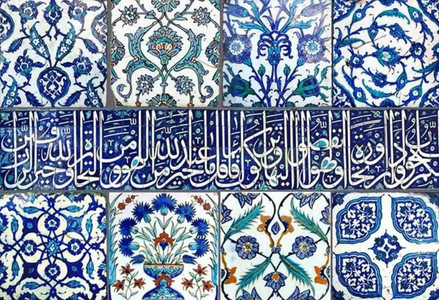
What visitors often call “the Blue Mosque effect” is really a very specific material technology: a brilliant white body and an underglaze-painted surface sealed beneath a fully transparent glaze, so the lines stay crisp and the colours sit in clean, glassy depth rather than reading as matte or absorbed.
In the best Ottoman tilework of this tradition, the palette is disciplined—deep cobalt, lighter blues, turquoise, greens, and the famous warm red—so the wall reads as a unified surface rather than a collage of panels. In technical terms, this clarity isn’t “just craft talk”: laboratory studies of İznik ceramics describe bodies with very high quartz content and an underglaze decoration applied over a fine white slip, then covered by a lead-alkali glaze that remains transparent enough for the colour to read sharply.
In other words, the mosque’s “blue” is not only pigment; it is an optical result created by layering (white base + mineral colourants + clear glaze) and controlling how light rebounds off that surface.
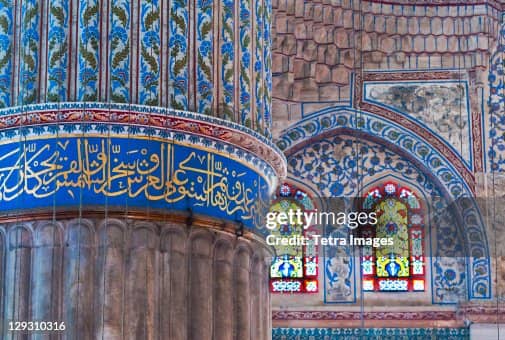
Inside the Blue Mosque, that technology is deployed at scale: you are effectively walking through a curated field of tilework, often summarised as more than 20,000 İznik tiles rising across the mid-level zones of the interior. The motifs do a second kind of work beyond colour, constructing a legible Ottoman vocabulary of “paradise”—tulips, roses, cypress trees, fruits—repeated with enough variation to feel alive, yet with enough consistency to read as imperial rather than domestic. Daylight amplifies the effect: light enters through hundreds of openings across domes and walls, so the tiles do not sit in shadow like a museum object; they brighten and soften across the day, turning decoration into atmosphere.

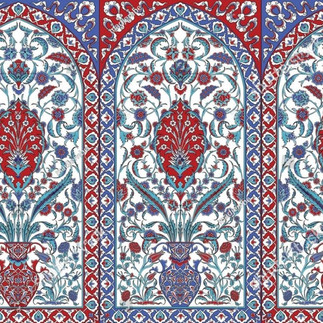

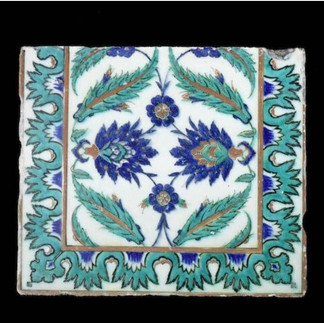

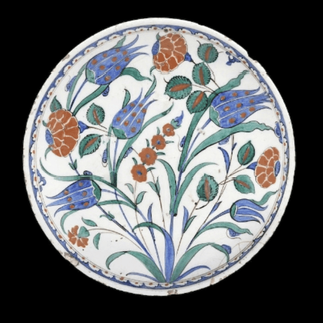


Then comes the most difficult ingredient: the red. Sources describing classical İznik emphasise that the celebrated “tomato red” (often linked to Armenian bole) had to be applied very thickly, so it rises in relief from the surface “like sealing-wax,” and that mastering it consistently was both late and fragile—fully achieved for a relatively tight window and then increasingly lost again in the early seventeenth century.
That single detail matters for how Sultanahmet reads today: when the red fires perfectly, it gives the wall a luxurious, almost jewel-like punctuation against cobalt and turquoise; when it fails, it can turn muddy or brownish, flattening the palette and making it feel less “electric.” The same point shows up in site-based observations in the city: the reds are sometimes noted as less clean than the blues and turquoises, a reminder that even at the imperial scale you are seeing a craft tradition at the edge of its peak. So the “blue” in the Blue Mosque is slightly misleading: in the best moments, it becomes a controlled three-colour conversation—cobalt depth, turquoise lift, and coral-red accents that add heat and rank. And because the decoration is not confined to a few isolated patches but climbs across surfaces—walls, piers, galleries, and the zones between windows—the tiles do not merely ornament the architecture; they discipline it. The massive supports and structural rhythms are visually softened into a continuous garden-language, while the calligraphic bands and repeating floral grammars keep the space feeling authored rather than accidental. That is why Sultanahmet’s tilework became the building’s public identity: it does not sit on top of the mosque; it is one of the ways the mosque performs Ottoman power—through controlled beauty, repeated mastery, and a material brightness that makes stone feel weightless.
From Workshop to Auction Room: İznik Tiles, Decline, and Modern Value
The “Blue” in the Blue Mosque is not just a colour choice—it is the afterimage of a craft economy that peaked, strained, and then began to fade. By the mid-sixteenth century, the classic İznik technique (painted under a perfectly clear glaze on a brilliant white ground) had reached its most confident vocabulary: deep cobalt, turquoise, greens, and—most famously—the raised “tomato red” made from Armenian bole, a pigment so temperamental that it was only fully mastered for a relatively brief window and then, by the early seventeenth century, increasingly lost again; after that, reds often drift muddy or brownish and outlines lose their crispness.
In that sense, Sultanahmet is both a climax and a threshold: one of the last monumental interiors to demand huge quantities of late İznik production, bathing the prayer hall in blue floral fields while also revealing, in places, the early signs of a system under pressure—technical difficulty, workshop fatigue, and changing imperial priorities.
As court commissions thinned and the old kiln network weakened, later attempts at revival shifted production toward Istanbul (Tekfur Saray is the classic example cited for an eighteenth-century afterlife), but the arc was clear: fewer masterworks, more substitutes, and a growing sense—already felt by careful observers—that an incomparable standard had slipped.
Today, that same material history is reflected in the art market: single İznik tiles can realise five-figure sums even at the conservative end (for example, a tile selling for £22,500 at a major London sale), while larger panels and multi-tile compositions can move into the tens of thousands (e.g., a panel realising £40,250 in a past auction). What drives value is exactly what Sultanahmet displays at architectural scale—colour saturation, clean drawing, intact glaze, and above all that difficult red—yet the market story has a darker twin: the dispersal of architectural tiles. Museum records explicitly describe panels removed from Istanbul mosques and acquired into collections in the late nineteenth century, which helps explain why so many Ottoman tile fields survive today as “portable” fragments rather than intact walls. And in the case of the Blue Mosque itself, modern restoration reporting has noted long-standing losses (including stolen tiles) and the contemporary practice of replacing missing areas with reproductions—an uncomfortable reminder that what began as public devotional ornament has also become globally tradable heritage.
The Sultan’s Resting Place: Tomb and Hazire
Just outside the mosque’s northern precinct—tucked beside the madrasa—Sultan Ahmed I’s tomb turns the külliye into something more than an architectural statement: it becomes a dynastic memory-space, where political fragility and family tragedy sit quietly behind carved stone and tiled walls. Contemporary guide and heritage overviews note that the square-plan türbe holds Ahmed I together with Kösem Sultan and members of his immediate family, including Osman II and Murad IV, alongside other princes and princesses.
The placement matters: visitors come expecting the “Blue Mosque,” but the tomb’s proximity gently shifts the experience from spectacle to aftermath—reminding you that the patron died very young, and that the world he tried to stabilise did not settle quickly.
The burials also underline a harsher Ottoman reality: monumental building did not guarantee a long reign, and even a sultan’s son could leave no architectural imprint of his own. One commonly repeated historical framing notes that Osman II—having commissioned no külliye—was ultimately interred beside his father at Sultanahmet.
That detail makes the türbe feel less like a separate annex and more like a closing bracket on the mosque’s founding story: the patron’s prestige project becomes, almost immediately, the family’s mausoleum—power and piety culminating not in triumphal permanence, but in a concentrated, almost intimate cemetery logic.
Kösem Sultan and the “Sultanate of Women”: The Power Behind the Mosque
The tomb beside Sultanahmet is where the building’s founding story quietly spills into the political reality that followed: the mosque may carry Ahmed I’s name, but the dynasty that gathered around it was soon shaped by the palace, the harem, and the women who could hold the state together when sultans were young, absent, or unstable. One major narrative of the period traces this transformation to the moment the harem became physically and politically central to rule, framing it as the beginning of the era later labelled the “Sultanate of Women,” when the inner palace could steer the empire as decisively as the council chamber.
In Kösem’s case, that influence was not abstract: she emerges as a figure whose authority expanded across successions and crises, culminating in an open struggle over who would control the throne during a child-sultan’s reign—an arc described in Istanbul-focused history writing as a rivalry between Kösem and the grand vizierate, and later as an intensifying conflict between Kösem and her daughter-in-law Turhan Sultan, with palace factions (especially the ağas) often determining outcomes.
The stakes were brutally concrete: wartime pressure and scarcity in the capital amplified public anger; Kösem’s dominance drew backlash; and when she attempted to neutralize Turhan through a palace plot, the counter-move ended in her assassination. Power in the “women’s sultanate” was real power, and it could be fatal.
Modern scholarship treats this period not as a courtly curiosity but as a structural feature of seventeenth-century governance, in which regencies, kinship, and household politics became instruments of sovereignty.




The Surre Processions: Istanbul’s Annual Line to Mecca and Medina
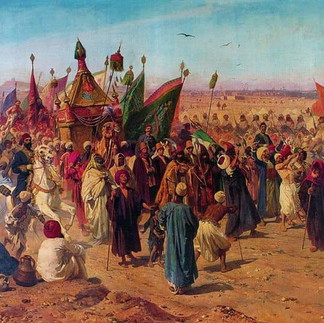
For the Ottoman court, the bond with Mecca and Medina was not only theological—it was performed, financed, and renewed as a state ritual. The surre was the name given to the money, goods, and gifts sent for distribution in the Haremeyn during the pilgrimage season. What matters for our story is the form this duty took in Istanbul: an annual departure that turned the capital into a ceremonial engine—officials appointed for the mission, pouches of funds prepared, gifts assembled, and a public send-off staged to remind onlookers that the sultan’s legitimacy stretched beyond the Bosphorus toward the Hijaz.
Crucially, this was not an invisible administrative dispatch; it was a procession the city could watch. Descriptions of the ceremonial route emphasise that the caravan was brought out through the Bâb-ı Hümâyun and moved across the historic core toward the waterfront before being transferred to Üsküdar. This means the Surre’s “departure” belonged to the same imperial stage as Sultanahmet itself: Atmeydanı—Ottoman Istanbul’s name for the square directly in front of the Sultan Ahmed Mosque—lay on the public axis where processions, protocol, and power were made visible. From there, the ritual continued toward Üsküdar, remembered as the key gathering point from which the Surre-i Hümâyun set out on its long road to Mecca and Medina.
Today’s Blue Mosque: Living Worship, Mass Tourism, and Conservation Under Pressure
Today the Blue Mosque is not a “museum monument” but a working imperial mosque that also sits at the heart of Istanbul’s tourism economy—so each day it has to balance worship, crowd flow, and heritage protection in real time. The building fully reopened after a comprehensive restoration that began in 2018 and was reported as completed in April 2023, and since then it has returned to its double life: a space of prayer, with visitor access restricted during prayer times, and one of the most visited sites on the Historic Peninsula.
That peninsula is part of UNESCO’s “Historic Areas of Istanbul” World Heritage property, which places the monument within a broader conservation framework concerned with issues such as development pressure and tourism impacts. In practice, this helps explain why the visitor experience can feel more actively managed than romantic: clearer routing between visitors and worshippers, more explicit dress-and-behaviour guidance, and a continuing emphasis on maintenance—not because the mosque has lost its aura, but because popularity itself has become one of its central conservation risks.
As a private tour guide in Istanbul, this is exactly why I love starting a walk in Sultanahmet Square (Atmeydanı): in just a few steps you can read layers of empire—Hippodrome ground, palace memory, and the Ottoman claim written in stone. On my website, I share these blog posts to help you see the square the way locals and historians do: not as a single “must-see stop,” but as a living crossroads where architecture, ritual, and power overlap. If you’d like, we can experience this area together on a private walk—at the right pace, with the right pauses, and with the stories that make these monuments feel real.
Bibliography
Kaya, Önder. İstanbul Tarihi: İmparatorluklar Başkentinin 2500 Yıllık Tarihi. İstanbul: Kronik Kitap, 2024.
Madden, Thomas F. Istanbul: City of Majesty at the Crossroads of the World. New York: Penguin Random House / Penguin Books, 2016.
Sumner-Boyd, Hilary, and John Freely. Strolling Through Istanbul: The Classic Guide to the City. London: I.B. Tauris, 2010.

It is a really strong article .